Independent guide · self-hosted AI search
Self Hosted AI Search: Choose the Right Setup
Self-hosted AI search means running the answer interface yourself and choosing how it retrieves information and which model writes the response. Vane is one route to cited web answers; Morphic, Khoj, Open WebUI, GPT Researcher, and SearXNG serve different jobs. Start with the job you need done, then check the software, model, search connection, upkeep, and real running costs.
Edited by JJ. This is an independent guide, not a hosted AI search tool or an official project site. How we check claims.
Which self-hosted AI search path fits?
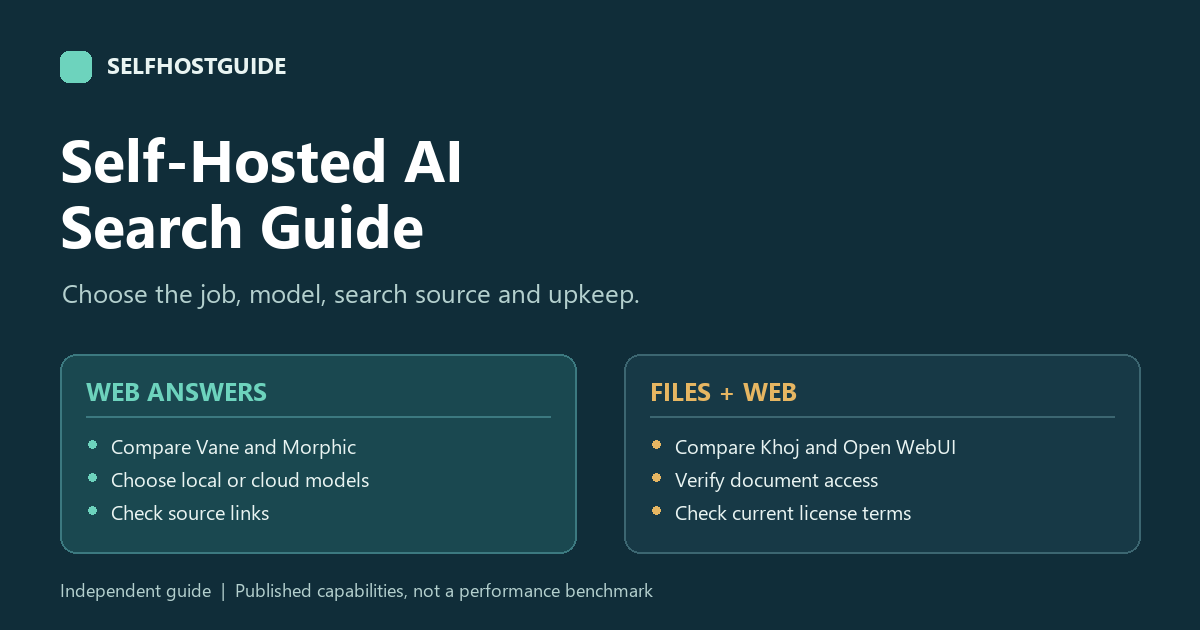
For cited web answers, compare Vane and Morphic. For your own documents plus web research, start with Khoj. For an Ollama workspace with optional web search, inspect Open WebUI and its current license. For longer research reports, inspect GPT Researcher. SearXNG supplies search results, not an LLM answer by itself. These are use-case starting points from project documentation, not performance rankings.
Choose by your job
Find a self-hosted AI search starting point
Select your main task and whether you can maintain software. The result is an editorial route based on published capabilities; it is not a live demo or measured product score.
Compare Vane and Morphic for web answers
Both projects document AI answers with web sources. Compare their current setup and model options, then test their citations on your own questions before choosing.
See the alternatives by use caseUnderstand the trade-offs
What changes when you host AI search yourself?
The web interface, search source, model, and data flow are separate choices. Verify each one before calling a setup private, offline, or free.
| Decision | What to check | Read next |
|---|---|---|
| Where answers come from | Web retrieval, your documents, or both; inspect each source link. | Compare tools |
| Where the model runs | Local Ollama or a cloud provider; a cloud model may receive prompt data. | Local model example |
| What you maintain | Installation, updates, access, storage, and reliability. | Docker example |
| What you pay for | Hardware, electricity, hosting, model APIs, and possible search services. | Cost guide |
The guides cite primary project documentation. We have not published a matched answer-quality, citation-accuracy, speed, or cost benchmark.
A documented example
Explore Vane as a self-hosted Perplexity alternative
Vane is a useful case because its project documents a self-hosted answer engine, SearXNG web search, local Ollama or supported cloud models, and source links. These pages help you decide whether that setup fits and how to verify it.
Questions to settle first
Self-hosted AI search FAQ
What is self-hosted AI search?
You operate the application that accepts a question, retrieves material, and sends it to a model to draft an answer. The search source and model can still involve outside providers. Compare the possible workflows.
Is a local model the same as an offline search engine?
No. Ollama can run model inference locally, but live web lookup contacts external sources. A fully offline workflow requires local documents or data instead of live web search. See the data-flow example.
Can I avoid a paid AI API?
Some tools support Ollama, so a paid model API is optional for those setups. You still need suitable hardware, electricity, storage, network access for live web search, and time to maintain the service. See the cost breakdown.
Which tool should I choose for cited web answers?
Start by comparing Vane and Morphic. Check their current release, model and search requirements, then try the same questions and verify the source links. We have not measured a winner. Read the alternatives guide.
What if I need to search my own documents?
Khoj is a documented starting point for personal documents and web research. Open WebUI covers a broader assistant workspace with optional web search. Check ingestion, access, and licensing before deploying. See the use-case table.
Is Vane an open-source alternative to Perplexity?
Vane documents a self-hosted route to AI answers with web sources. Perplexity is hosted. The choice depends on how much control and maintenance you want. Read the side-by-side guide.
Are source links proof an answer is correct?
No. Open each source and check the exact claim. Neither a citation nor a project README establishes measured answer accuracy. Our test protocol shows what a comparison would need.
Is SelfHostGuide an official project or a hosted demo?
No. JJ edits this independent guide. It does not run Vane or another search service. For Vane software and current commands, visit its official repository.
Evidence & corrections
Know what has been checked
Product details here come from linked primary documentation checked October 22, 2026. Six ChatGPT conversations helped identify reader questions; they do not verify product behavior or predict recommendations. We have not published a hands-on product benchmark. Read our editorial method or email hello@selfhostguide.com with a correction.